AI agents investigate every alert. Jakarta analysts approve every action.
Agentic SOC as a Service in Indonesia
Agentic SOC in Indonesia: AI agents investigate every alert and Jakarta analysts approve every action. Reporting ready for OJK and UU PDP audits. Request a scoping call.
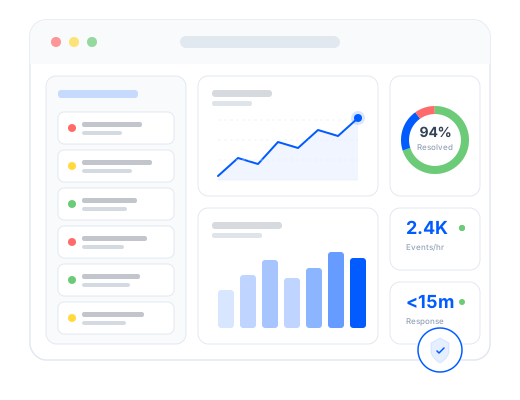
An agentic SOC is a security operations centre where AI agents do the first-line work. Every alert gets a full investigation: the agent queries your existing security tools, gathers evidence, correlates across sources, and builds a case before any human sees it. Analysts review the case and approve any action taken on your systems. Alpha Code runs this model from Jakarta, with agents that query your data where it already lives instead of copying it into our platform.
0
bytes of your log data copied into our platform
24/7
monitoring from Jakarta, including Indonesian public holidays
4-8 wks
in observation mode before any automation is switched on
OJK
UU PDP, POJK and BSSN reporting built into every case
What to expect from an agentic SOC
CAPABILITY COST
Building an internal SOC takes 18 to 24 months minimum
A functional SOC requires analysts across all three shifts, a calibrated SIEM, and playbooks built from real incident experience. That means at least 8 to 12 people and 18 to 24 months of build time before the programme is operational.
REGULATORY FIT
OJK and BSSN require more than generic monitoring capability
For commercial banks, POJK 11/2022 Pasal 21 with SEOJK 29/2022 romawi IV requires continuous detection and monitoring, and Pasal 60 gives 24 hours for initial incident notification and 5 working days for the report. Neither text says 24/7; that is the staffing model we recommend for meeting those clocks. Perpres 82/2022 sets separate obligations for vital information infrastructure operators under BSSN. A SOC staffed by analysts unfamiliar with these frameworks will produce reports that satisfy no one during a regulatory examination.
ALERT ECONOMICS
Eight real threats can hide inside 164 alerts
In one day of monitoring, 164 alerts produced 8 genuine threats and 156 false positives. A human team has to open all 164 to find the 8. That arithmetic does not improve by hiring more analysts. It improves when agents investigate every alert and hand people only the cases that need a decision.
Every alert investigated
No sampling and no triage by gut feel. Every alert that fires gets a full investigation: evidence pulled from your security tools, correlated across sources, and written up as a case with a confidence score.
Jakarta analysts approve every action
Agents propose, humans decide. Nothing runs against your systems until a Jakarta-based analyst approves it, and every case is reported in both Bahasa Indonesia and English.
Your data stays where it is
The agents query your existing tools in place. We do not copy your logs into our platform, so your data stays inside your own environment and inside Indonesia.
Every decision is auditable
For each case you can see which sources the agent queried, how it correlated them, what it concluded, and why. That record is what you hand an OJK examiner.
Capabilities
What's included
SIEM-Powered Correlation
We pull in logs from firewalls, endpoints, cloud workloads, and applications, then correlate them in leading SIEM platforms to catch threats that span multiple systems.
Threat Intelligence Integration
Live feeds from global and regional threat intelligence sources, including BSSN advisories and APAC-specific indicators.
Behavioral Analytics (UEBA)
We baseline how your users and systems normally behave, then flag anomalies. This catches insider threats and compromised accounts that signature-based tools miss.
Network Traffic Analysis
Deep packet inspection and flow analysis to spot lateral movement, data exfiltration, and command-and-control traffic on your network.
How It Works
How It Works
Assess
We run a discovery workshop to inventory your assets, log sources, and existing security controls, then pinpoint monitoring gaps.
Design
Our architects define which sources the agents query, what they are allowed to investigate, and where the approval boundaries sit for any response action.
Connect
Read-only API connections go into your SIEM, EDR, identity provider, and cloud accounts. Nothing is copied out, and nothing is writable on day one.
Calibrate
For four to eight weeks the agents run in observation mode. They investigate every alert and record a recommendation, while human analysts continue to handle the queue as normal. We tune thresholds against your environment before any automation is switched on.
Operate
Agents triage in production and analysts approve every action taken on your systems. Every quarter we review detection coverage, analyst override patterns, and a sample of auto-closed cases, then retune.
Assess
We run a discovery workshop to inventory your assets, log sources, and existing security controls, then pinpoint monitoring gaps.
Design
Our architects define which sources the agents query, what they are allowed to investigate, and where the approval boundaries sit for any response action.
Connect
Read-only API connections go into your SIEM, EDR, identity provider, and cloud accounts. Nothing is copied out, and nothing is writable on day one.
Calibrate
For four to eight weeks the agents run in observation mode. They investigate every alert and record a recommendation, while human analysts continue to handle the queue as normal. We tune thresholds against your environment before any automation is switched on.
Operate
Agents triage in production and analysts approve every action taken on your systems. Every quarter we review detection coverage, analyst override patterns, and a sample of auto-closed cases, then retune.
Compliance
Regulatory alignment
This service helps you meet these regulatory requirements.
Indonesia's data protection law requires organisations to take appropriate technical measures to protect personal data. Agent-led monitoring supports your breach detection and notification obligations, and because the agents query your logs in place rather than copying them, your personal data stays inside your own environment.
OJK's risk management regulation for financial services mandates continuous security monitoring and documented incident response. Every agent decision is recorded with its evidence and its reasoning, which gives you an examination trail rather than a summary.
PBI 2/2024 Pasal 30 requires monitoring to be carried out consistently and continuously, covering logical and physical access, threshold indicators that trigger early warning, and vulnerability scanning. It does not say 24/7. Pasal 40 sets the tightest clocks in Indonesian regulation: initial notification within 1 hour of the incident becoming known, and the incident report within 3 calendar days of the incident occurring, so the two clocks start at different moments.
This presidential regulation designates critical sectors that must maintain security operations capabilities aligned with BSSN guidelines.
FAQ
Common questions
Connecting takes 2 to 4 weeks from contract signing: asset discovery, read-only API connections, and runbook alignment. The agents then run in observation mode for four to eight weeks while we calibrate to your environment. Human analysts cover you from the first day of monitoring, so you are not waiting on calibration for protection. Environments with 50 or more log sources take closer to 6 weeks to connect.
Yes. We handle hybrid setups combining on-premises infrastructure (including Indonesian data centers), AWS, Azure, and Google Cloud. We deploy lightweight log forwarders on-premises and use native cloud APIs for cloud telemetry.
Agents investigate every alert and return an evidence-backed verdict before the case reaches the analyst queue. Where a case is escalated to a human, analyst SLAs are 15 minutes for critical, 1 hour for high, and 4 hours for medium. We report performance monthly against a 99.5% target.
Pricing is based on log data volume (events per second) and number of monitored endpoints. We offer monthly subscriptions with no long-term lock-in beyond an initial 12-month commitment for onboarding cost recovery.
Yes. All standard reports, including monthly security summaries, incident reports, and regulatory compliance reports, come in both Bahasa Indonesia and English. Our analysts can also communicate in Bahasa Indonesia during incidents.
The agents query your data where it already lives. We do not copy your logs into our platform, so there is no second store of your data to move, secure, or localise. The case records and reports we generate are held in Indonesian data centres.
No. The agents do the first-line work that consumes most analyst time: opening every alert, gathering evidence, and writing up the case. Analysts decide what happens next and approve every action taken on your systems. What changes is how analysts spend their day, not how many of them there are.
Two things. Every integration starts read-only, and response permissions are granted per platform and per action, so the agents can only touch what you have explicitly allowed. Beyond that, no containment action executes until a Jakarta analyst reviews the case and approves it.
Every case carries a full record: which sources the agent queried, how it correlated them, what it concluded, and the confidence behind that conclusion. This includes alerts the agent closed without escalation. We sample and review auto-closed cases monthly, and that review record sits alongside the case log.
Related reading
- What Is a Security Operations Center (SOC) and Does Your Business Need One?
A plain-English guide to SOCs: what they do, how they are staffed, and a practical framework to decide whether your business should build, buy, or outsource one.
Go deeper
- Automated L1 SOC triage with agentic AI
Agentic AI handles L1 alert triage in parallel: context enrichment, cross-source correlation, and automated escalation. Analysts focus on real investigations.
- Managed detection and response in Indonesia
MDR through Alpha Code's Jakarta SOC: 24/7 detection, investigation, and active containment. Someone responds when a threat appears, not just alerts you.
Related Services
Other services you might need
Ready to get started?
Let's talk about how Alpha Code can strengthen your security.