Industrial security testing that keeps your operations running
OT/ICS Security Assessment in Indonesia
OT/ICS security assessment using passive methods that never disrupt production. Covers SCADA, DCS, and PLC, mapped to IEC 62443. Request an assessment scope.
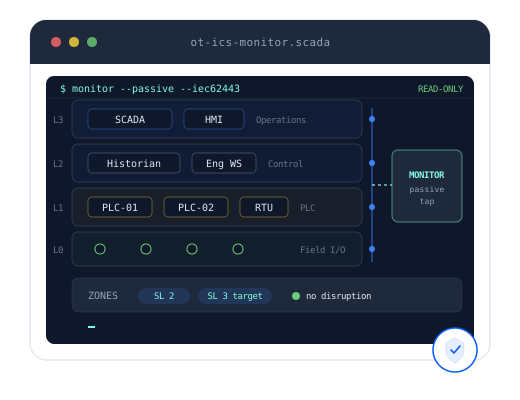
An OT/ICS Security Assessment is a specialised security review for industrial environments such as SCADA systems, PLCs, DCS networks, and industrial control infrastructure, conducted using passive methods that do not disrupt production. It is designed for Indonesian critical infrastructure operators in energy, utilities, and manufacturing who are subject to Perpres 82/2022 and need to assess their OT security posture against IEC 62443 requirements.
OT security is not IT security applied to machines
THE METHODOLOGY GAP
Standard penetration testing tools can stop industrial processes
A port scan that takes two seconds against a web server can take a Modbus PLC offline for minutes. SCADA servers running Windows XP cannot recover gracefully from unexpected packets. The tools and methods designed for corporate IT environments are genuinely unsafe in OT networks, which is why a separate assessment methodology exists.
THE CONNECTIVITY RISK
OT networks are more connected to the internet than most operators realise
The shift toward remote monitoring, predictive maintenance, and cloud-connected historians has created dozens of connectivity paths between corporate IT and industrial systems. Many were added incrementally, without security review, and some are unknown to the operations team. Passive discovery routinely surfaces connections that neither IT nor OT teams knew existed.
THE REGULATORY CONTEXT
Perpres 82/2022 places legal obligations on critical infrastructure operators
Indonesian critical infrastructure operators in energy, utilities, transport, and industry are subject to Perpres 82/2022, which requires them to protect critical information infrastructure. BSSN has published ICS/SCADA security guidelines to support implementation. An OT security assessment is the practical starting point for meeting those obligations.
Non-Destructive Methodology
OT environments cannot tolerate the active scanning used in IT pentesting. Our assessment relies on passive network discovery, protocol analysis, and configuration review, so production never stops.
Industrial Protocol Expertise
Our engineers understand Modbus, DNP3, OPC-UA, Profinet, and EtherNet/IP. We know how these protocols behave normally and what anomalies look like, which standard IT tools cannot detect.
Regulatory Alignment
Findings are mapped to IEC 62443 security levels, NIST SP 800-82, and Indonesian regulations under Perpres 82/2022 for critical infrastructure operators.
Jakarta-Based OT Team
Our assessors understand the operational constraints of Indonesian industrial sites, including oil and gas facilities, manufacturing plants, and utility operators.
Capabilities
What's included
Passive Network Discovery
We identify all devices on your OT network without sending active probes. This includes PLCs, RTUs, HMIs, engineering workstations, historians, and any IT/OT boundary devices.
IT/OT Segmentation Review
We map where your IT and OT networks connect and assess whether those boundaries are enforced. Flat networks with direct connectivity between corporate IT and industrial control systems are the most common critical finding.
Industrial Protocol Analysis
We capture and analyse traffic on industrial protocols including Modbus, DNP3, OPC-UA, Profinet, and EtherNet/IP. We look for authentication gaps, unencrypted commands, and abnormal traffic patterns.
How It Works
How It Works
Site Survey and Scoping
We work with your operations and engineering teams to define assessment scope, safety constraints, maintenance windows, and emergency contacts before any activity begins.
Passive Discovery
We connect monitoring sensors to span ports or taps on your OT network segments. No active probes are sent. We collect device inventory, protocol traffic, and network topology data.
Configuration and Architecture Analysis
We review device configurations, network diagrams, firewall rules, and remote access policies offline, without touching live systems.
Vulnerability Analysis
We correlate passive discovery findings with known OT/ICS vulnerabilities, CVE data for identified firmware versions, and IEC 62443 requirements to produce a prioritised finding list.
Reporting and Debrief
We deliver an executive summary and technical report in Bahasa Indonesia and English. A debrief session walks your operations and IT teams through findings and remediation priorities.
Remediation Support
We help you build an OT security improvement roadmap. For critical findings, we can support your team through remediation planning and provide a follow-up review.
Site Survey and Scoping
We work with your operations and engineering teams to define assessment scope, safety constraints, maintenance windows, and emergency contacts before any activity begins.
Passive Discovery
We connect monitoring sensors to span ports or taps on your OT network segments. No active probes are sent. We collect device inventory, protocol traffic, and network topology data.
Configuration and Architecture Analysis
We review device configurations, network diagrams, firewall rules, and remote access policies offline, without touching live systems.
Vulnerability Analysis
We correlate passive discovery findings with known OT/ICS vulnerabilities, CVE data for identified firmware versions, and IEC 62443 requirements to produce a prioritised finding list.
Reporting and Debrief
We deliver an executive summary and technical report in Bahasa Indonesia and English. A debrief session walks your operations and IT teams through findings and remediation priorities.
Remediation Support
We help you build an OT security improvement roadmap. For critical findings, we can support your team through remediation planning and provide a follow-up review.
Compliance
Regulatory alignment
This service helps you meet these regulatory requirements.
Indonesia's Presidential Regulation on Vital Information Infrastructure Protection requires operators in 8 strategic sectors including energy and mineral resources, transportation, and finance to protect their information systems. An OT/ICS security assessment is the standard way to demonstrate compliance with protection requirements.
The international standard for industrial cybersecurity defines security levels (SL 1 to SL 4) for OT environments. Our assessment measures your posture against each applicable security level and identifies gaps.
The NIST Guide to Operational Technology Security is widely referenced in oil and gas, utilities, and manufacturing. We align findings and recommendations to its control framework.
FAQ
Common questions
IT penetration testing tools send active probes and exploit attempts that can cause PLCs, RTUs, and SCADA servers to crash, freeze, or behave unpredictably. In an industrial environment that means process shutdowns, equipment damage, or safety incidents. OT assessments use passive methods that gather the same intelligence without touching device logic.
No. Our passive approach runs during normal operations. Activities that involve any direct device interaction, such as reviewing configurations on an HMI, are scheduled during planned maintenance windows at your team's discretion.
SCADA systems, distributed control systems (DCS), programmable logic controllers (PLCs), remote terminal units (RTUs), human-machine interfaces (HMIs), engineering workstations, industrial historians, and the network infrastructure connecting them, including industrial firewalls and data diodes.
Passive discovery typically runs for one to two weeks to capture representative traffic patterns, including shift changes and batch cycles. Configuration review and analysis adds another one to two weeks depending on the number of systems in scope. You get the final report within four to six weeks of engagement start.
Yes. We have experience assessing OT environments in upstream and midstream oil and gas, including wellhead control systems, pipeline SCADA, and refinery DCS environments. We understand the specific safety and operational constraints of these sites.
Related Services
Other services you might need
Ready to get started?
Let's talk about how Alpha Code can strengthen your security.